Why I set it up this way
Axioprax is me. The work I sell is Shopify operations, CRM and automation for stores in the US and UK. Since 28 October I have published a new fix page every day, written cold emails backed by a real ChatGPT test, answered questions on Reddit, posted on X, Threads, LinkedIn and YouTube, and checked all of it. No one person has the hours for that by hand.
So I stopped asking "which AI tool should I use?" and started asking a duller question: which jobs repeat every day, and which ones need my judgment? Everything that repeats got a schedule, a place to write its output and a person (me) who sees the result.
Who does what?
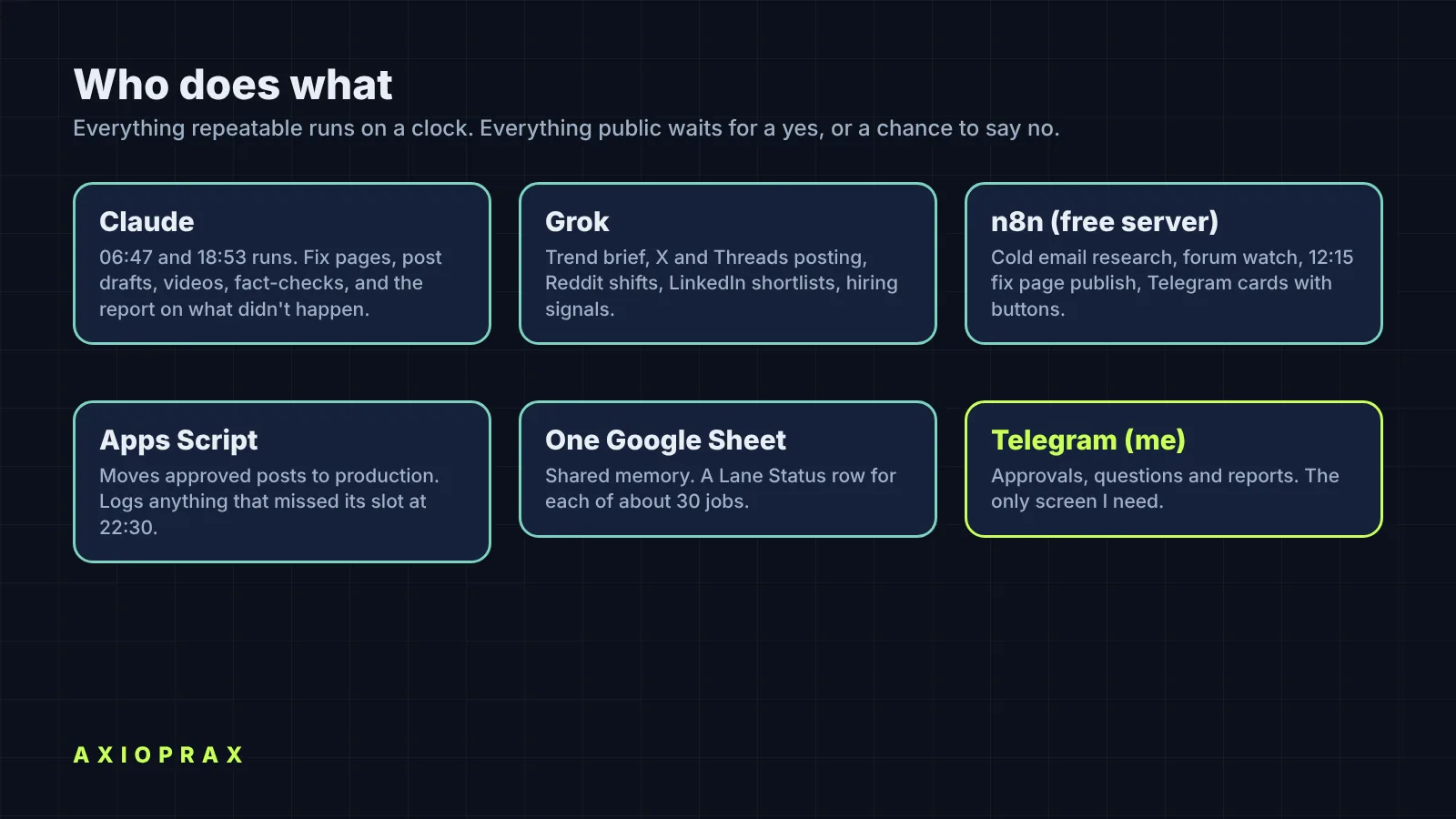
- Claude runs two scheduled jobs a day, at 06:47 and 18:53. It writes the fix pages, drafts the social posts, makes the short videos, checks that every other job actually ran, and sends me a report.
- Grok handles the lanes that live on X and in browsers: a trend brief each morning, posting on X and Threads, answering on Reddit in three shifts, finding people on LinkedIn worth talking to, and spotting companies whose job ads describe a problem we fix.
- n8n, on a free Oracle Cloud server, runs the pipes: researching cold email leads, watching community forums for new questions, publishing the day's fix page at 12:15, and turning everything that needs me into a Telegram card with buttons.
- Google Apps Script moves approved content between folders and logs anything that missed its slot at 22:30.
- One Google Sheet is the shared memory. Every tool reads from it and writes to it. One tab, Lane Status, has a row for each of about 30 jobs, with when it last produced something and whether it is red.
- Telegram is the only screen I need. Approvals, questions and reports all arrive there.
What does a normal day look like?
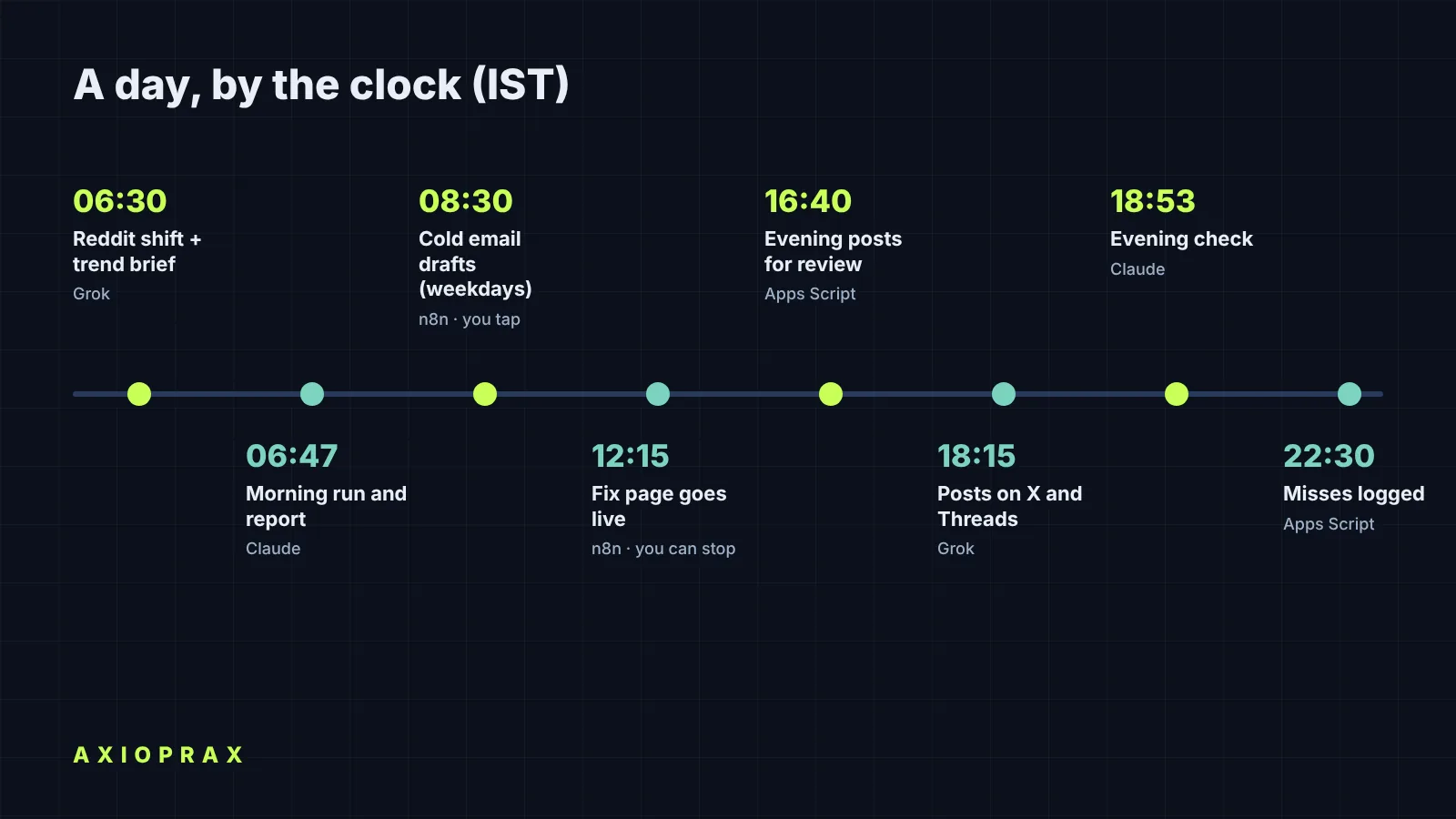
- 06:30 to 07:30. Grok's first Reddit shift and the trend brief. Claude's morning run checks the night's logs, fixes what it can and sends me a numbered list of what needs me.
- 08:30 on weekdays. The cold email feeder drafts the day's emails. Each one includes a real test: a shopper's question about the store's own products, asked in ChatGPT, and the stores it named instead. Each draft arrives as a card. Nothing is sent until I tap Approve.
- 12:15. The day's fix page goes live, unless I tapped Stop on the 11:00 card.
- 16:40. That evening's posts arrive for review. At 17:45 they move to production unless I stop them.
- 18:15 onwards. Grok posts on X and Threads. Claude's evening run checks what went out, what didn't, and why.
- 22:30. Anything that missed its slot gets logged, so it shows up in the next morning's email instead of quietly vanishing.
What do I still do by hand?
More than people expect, and that is on purpose.
- I approve every cold email, one tap per email.
- I decide anything with a judgment call in it: whether to reply to a price question, whether a risky forum answer goes out, whether a catch-up post still makes sense a week late.
- I record the screen recordings myself. The AI writes the script and builds the motion videos, but it cannot click through a real store for me.
- I write and send LinkedIn messages myself. Agents only send a handful of connection requests a day, inside strict limits, because my profile is not something I let an agent put at risk.
Most days that is a list of taps and a handful of real decisions. The rest of my day goes on work that needs a person.
What broke in the first three weeks?
Quite a lot. These are the ones worth knowing about if you try this yourself.
- A forum warned us for undisclosed AI. The HubSpot Community marked one of our answers as spam because it was written with AI and didn't say so. It was the second warning, so I stopped answering there completely. Our Shopify Community answers now say they were drafted with AI help.
- Reddit blocked the server's browser. Requests from a data-centre address hit rate limits, and answers that were ready never went up. They now get held and posted in the next shift instead of being lost.
- Reports silently stopped reaching my phone. For a couple of days, any report containing an underscore or an angle bracket was rejected by Telegram's formatting rules. Nothing looked broken from the outside. I only noticed because a morning report didn't arrive.
- The morning email cried wolf. It listed every task from the day before as "missed", including the ones that had run fine. A one-line filter fixed it, but for a few days it trained me to ignore the email, which is worse than having no email.
- An agent undid a Like. While opening a list of people who reacted to a post, the browser clicked the wrong thing and removed my own Like. Harmless, but it is why agents now open those lists only from the post page.
- A video went out looking unfinished. Text overlapped and half the screen was empty. I caught it, the video was rebuilt the same morning, and the first version never went public.
Which rules keep it from going wrong?
- Nothing public goes out without a human yes, or a human chance to say no. Cold emails need a tap. Posts and fix pages go out on a timer that I can stop.
- An independent agent fact-checks every draft. It never sees the drafting. It opens every source and marks each claim correct, wrong or unsupported. On the first seven fix pages it found 7 wrong and 16 unsupported claims, all fixed before they went live. That one check is the reason I trust the rest.
- Every job writes a log, and something reads it. If a job ran but wrote nothing, it is red on the Lane Status tab and shows up in the morning report.
- One place to make decisions. Every question from every tool comes to the same Telegram chat as a card with buttons. If I have to go looking for a question, it doesn't get answered.
- Say when AI wrote it. In forums and on this site. People don't mind help from AI. They mind finding out later.
What does it cost to run?
Far less than a part-time hire. Here is what a setup like this costs at current list prices (US, November 2026):
- Claude Pro: $20 a month
- ChatGPT Plus: $20 a month
- SuperGrok: $30 a month
- n8n Community Edition, self-hosted: free
- A small server on Oracle Cloud's Always Free tier: free
- Google Sheets, Apps Script and Telegram: free
That comes to roughly $70 a month. Heavy daily use can push the Claude plan up to a Max tier, which starts at $100, so a realistic budget is $70 to $200 a month. The bigger cost is the setup time, and the discipline to read the morning report every day even when it is boring.
Could a store owner run their store this way?
Yes, and you can start smaller than this. Pick the three jobs you repeat every day: checking for stuck orders, answering the same five customer questions, and spotting stock that is about to run out are common ones. Give each one a fixed time, a place where its output lands, and one message to your phone when something needs you. Add the next job only when the first three have run for a week without you babysitting them.
The free fixes on axioprax.com/fixes are a good place to find those first jobs. Each one is a single problem, with the settings and steps to fix it.
Want this for your store?
If you'd like help setting up the first three jobs for your store, book a free 20-minute call. Bring the job you repeat most.
This article was drafted with AI help and checked by me.