
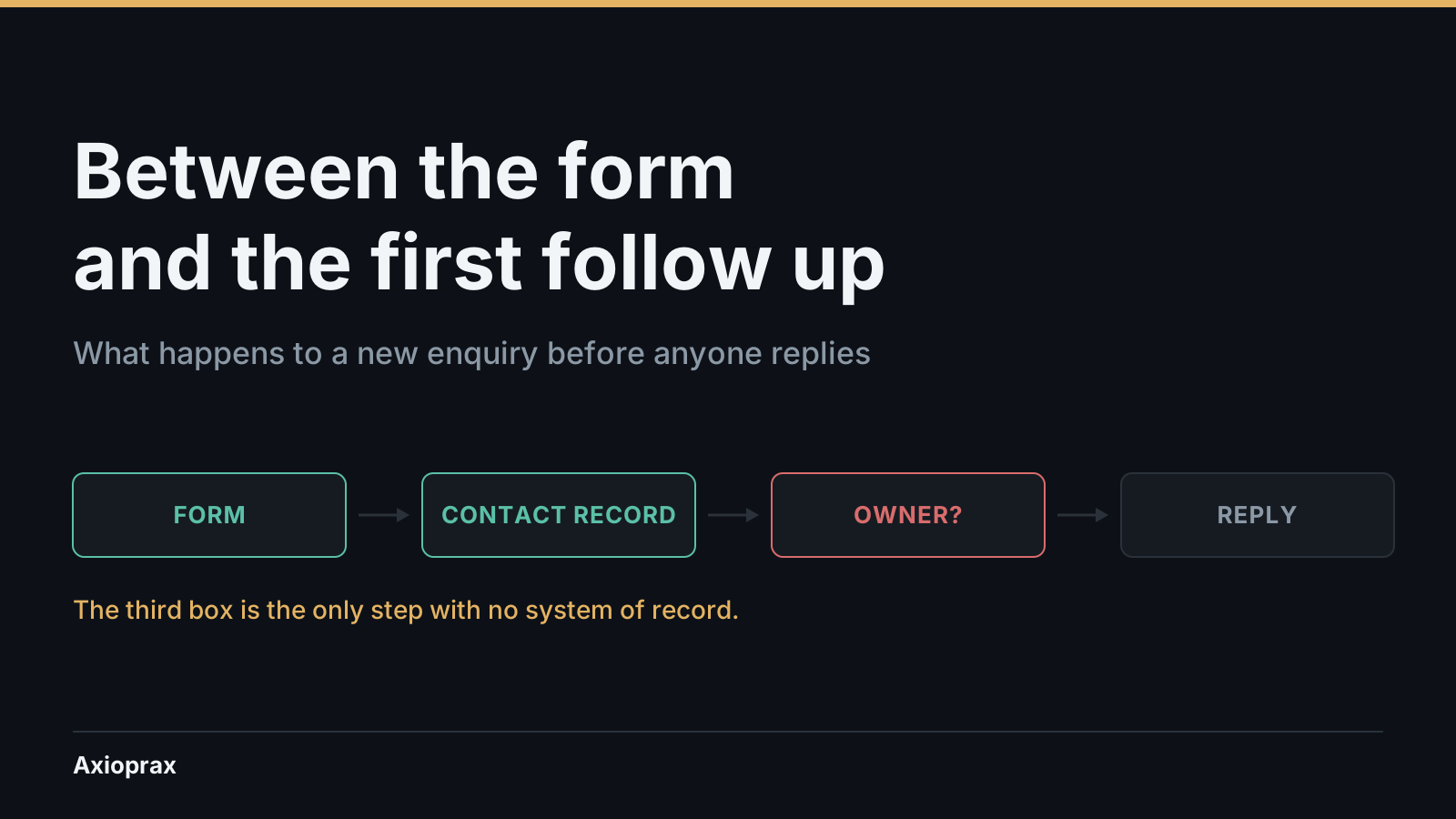
Someone filled in your form on Friday evening. Nobody replied until Monday. The uncomfortable part is not the delay. It is that when you ask whose job that reply was, nobody can answer, and there is no place in the system where the answer was ever recorded.
Most advice here is about speed, and you already believe speed matters. What you cannot see is the stretch between a form submission and a human reading it, because every step in it succeeds quietly. This article walks that stretch in the two stacks a one to fifty person company usually has, and shows where ownership goes missing.
Why it is hard to answer
The steps are invisible because none of them fail. The form submits. The record is created. The email is sent, or is not, according to a setting nobody has looked at since setup. Nothing raises an error, so nothing tells you an enquiry was captured correctly and then read by no one.
Ownership is a setting, not a conversation. HubSpot's documentation is direct about the consequence: If a contact has no owner, no notifications will be sent
(HubSpot Knowledge Base, form submission notifications, checked 18 September 2026). A correctly captured enquiry can be completely silent, and the silence looks identical to a quiet week.
The fix you assume is paywalled is mostly not. Both the record ownership page and the form notification page carry the requirement line All products and plans
(HubSpot Knowledge Base, checked 18 September 2026). Setting an owner and sending notifications are available across plans. Only automatic distribution is gated, which is a narrower problem than most people expect.
How it actually works
Start with the asymmetry, because everything else follows from it.
If a user manually creates a record, that user will be automatically set as the record's owner, unless they select a different owner during creation
(HubSpot Knowledge Base, record ownership, checked 18 September 2026).
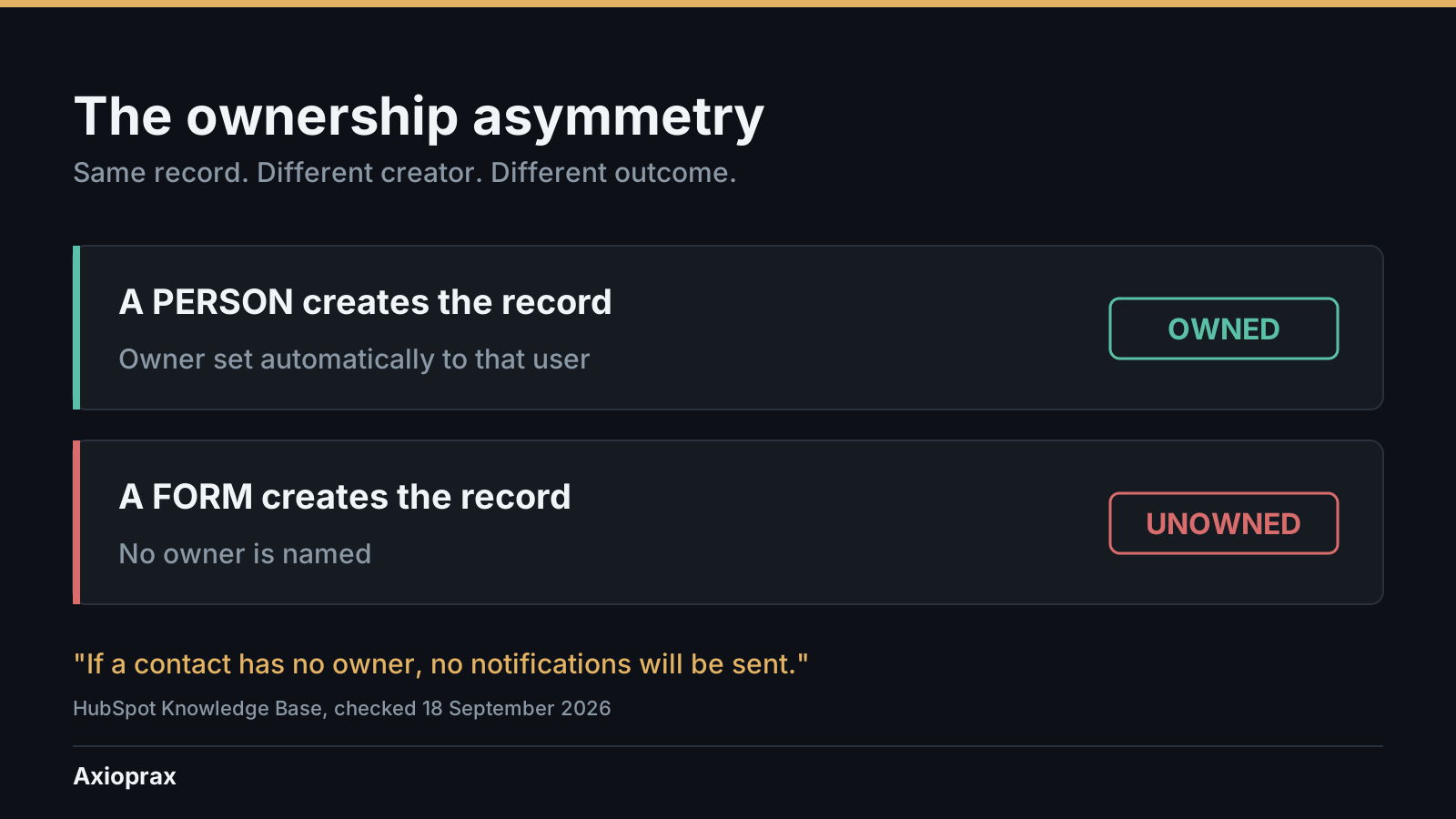
When a person types a contact into the CRM, ownership is automatic. When a form creates that same contact, nobody is named. The system behaves differently depending on who created the record, and the case with no human in the loop is exactly the case that gets no owner.
The HubSpot path. A submission arrives. If the email matches an existing contact, the details on the existing record will be updated
(HubSpot Knowledge Base, create and edit forms, checked 18 September 2026); otherwise a new contact is created. Form-level automation then runs inside tier limits: one action on free accounts, three on Starter, Professional or Enterprise without Marketing Hub, ten on Marketing Hub Starter, unlimited with multiple workflows on Marketing Hub Professional and Enterprise (HubSpot Knowledge Base, form automations, checked 18 September 2026). An owner is assigned, or is not. Notifications fire, or do not. And the recipient list has its own quiet rule: Notification recipients must be active users in your HubSpot account
(HubSpot Knowledge Base, checked 18 September 2026).
The tier wall sits on distribution. The assignment rotation workflow action requires a Sales or Service Hub Professional or Enterprise subscription plus an assigned seat (HubSpot Knowledge Base, record ownership, checked 18 September 2026).
The Shopify path. The default theme contact form is thinner. Your contact form sends all submissions to your store's sender email address
(Shopify Help Center, add a contact page, checked 18 September 2026). That is all the page documents. Whether the submission creates any customer record is not stated on it; that page has now been read five times across seven days and is silent every time. Silence is not denial, so this article will not tell you no record is created. It tells you the documentation does not describe one, and that this is a two minute test in your own store.
The separate Shopify Forms app behaves differently: A customer profile is created for new customers, and existing customers have their information matched to their profile
, though Contact information isn't updated when an existing customer submits a form
(Shopify Help Center, manage forms, checked 18 September 2026). Do not read that across to the theme contact form.
The common point of failure in both stacks is the handoff from captured to owned. It is the only step in the chain with no system of record.
One worked calculation
This is a model, not a measurement. The inputs are assumptions. Substitute your own.
Assume 30 web enquiries a month, working hours Monday to Friday 9am to 5:30pm, and for the moment that enquiries arrive evenly across the week.
Working hours per week: 5 x 8.5 = 42.5. That leaves 168 - 42.5 = 125.5 hours, so 125.5 / 168 = 74.7 percent of the week is outside working hours. Applied to 30 enquiries: 30 x 0.747 = 22.4 enquiries a month arriving when nobody is working.
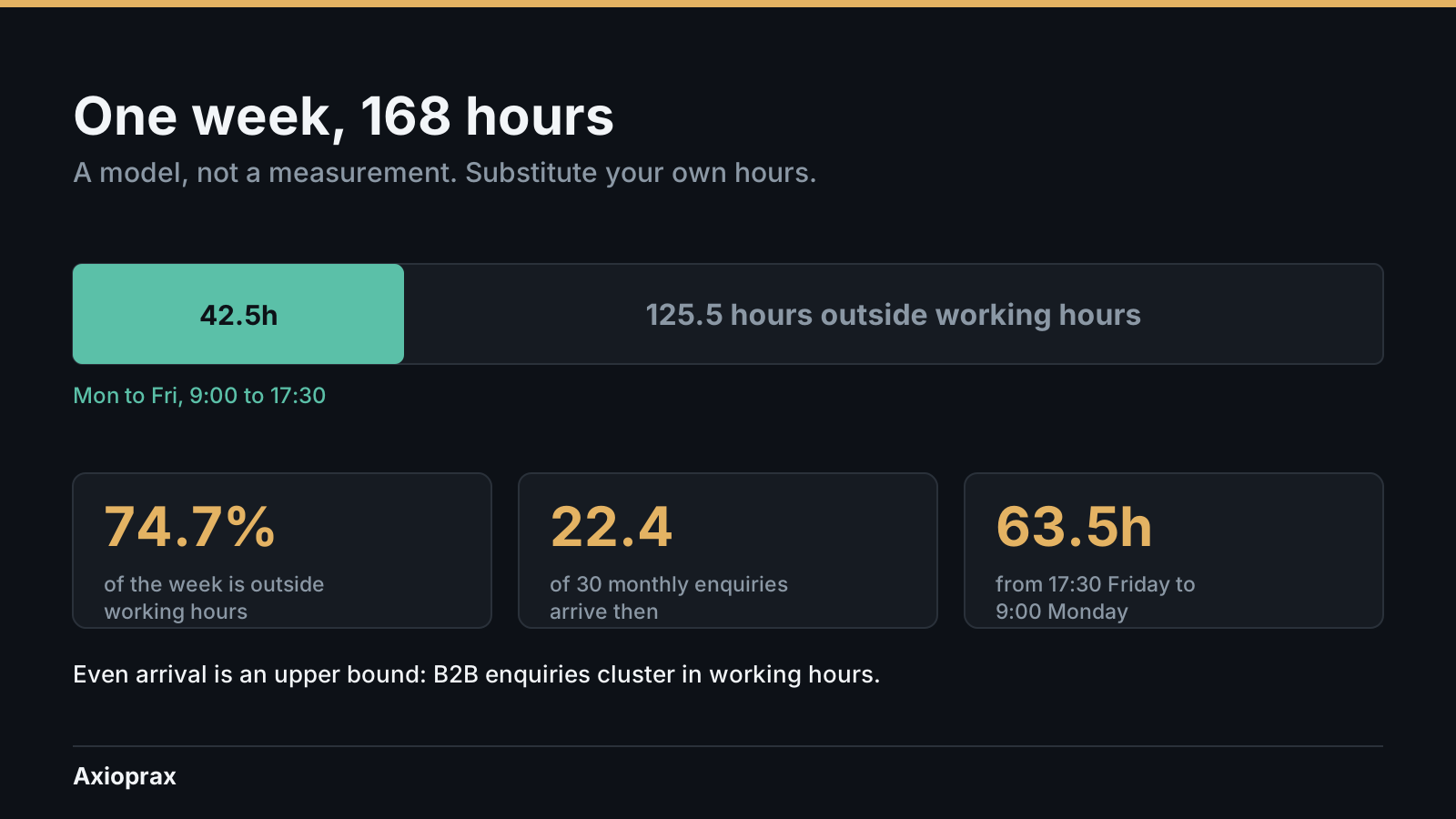
The even-arrival assumption is wrong in a known direction: B2B enquiries cluster in working hours, so 74.7 percent is an upper bound, not an estimate. What survives the objection is the single case. From 5:30pm Friday to 9am Monday is 63.5 hours, and an enquiry arriving then with no owner and no out-of-hours rule waits all of it before anyone is scheduled to look.
For scale, an audit of 2,241 US companies found that among those that responded at all within 30 days, average first response time was 42 hours, and that 37 percent replied within an hour while 23 percent never replied (Oldroyd, McElheran and Elkington, The Short Life of Online Sales Leads, Harvard Business Review, March 2011). That study is fifteen years old and US-based. A single unowned weekend enquiry exceeds its 42 hour average on its own.
The same study reports firms contacting a lead within an hour were roughly seven times as likely to qualify it, and more than sixty times as likely as those waiting a day or more. This model does not multiply anything by sixty. That figure is an association across a sample whose base rates are not yours, and turning it into revenue would produce a large number that means nothing. The model stops at hours waited.
A current benchmark would be better, but there is no credible one. The most prominent reachable 2026 report calls itself a compilation and traces its headline figures to that same 2011 dataset, with no original fieldwork (checked 13 September 2026). Whether response times have improved since is unknown.
Failure modes, and the symptom of each
- Unowned contact. No notification fires. Symptom: enquiries discovered later in the CRM, already cold.
- Notification to a shared inbox with no named owner. Symptom: replies that begin “I thought you had this one.”
- Out-of-hours arrival. Not lost, queued behind a weekend. Symptom: your slowest replies cluster on Mondays.
- Duplicate under a second email address. Matching is on email, so a second address makes a second record. Symptom: two half-conversations with one person.
- Automation built, working, with nobody owning its exception queue. A failed action is silent in exactly the way the original problem was silent.
- A departed colleague still on the notification list. Recipients must be active users, so a deactivated one drops off quietly. Symptom: a route that worked last quarter and now goes nowhere.
When not to automate
Below roughly five enquiries a week, a named person and a recurring calendar reminder beat a workflow, which becomes one more thing to maintain that the volume never repays.
Automate when volume is steady, when enquiry types are similar enough to route by rule, and when someone owns the exceptions. Do not automate to compensate for nobody owning intake. That is the problem, and a workflow on top of it just moves the silence somewhere harder to see.
Tradeoffs
| Approach | What it costs | What it fixes | What it breaks | When it is the wrong choice |
|---|---|---|---|---|
| Shared inbox, no assignment | Nothing | Nothing. This is the baseline. | Ownership is ambiguous by default | Any volume above a handful a week |
| One named owner for all intake | Agreement, nothing more | Ambiguity, immediately | Single point of failure, holidays | When that person is also delivery |
| Manual triage rota | A recurring calendar commitment | Ownership and out-of-hours cover | Depends on discipline, fails quietly | When the rota has no visible record |
| CRM auto-assign to one owner | Available on all plans | Notification silence | Everything lands on one person | When enquiry types need different people |
| HubSpot assignment rotation | Sales or Service Hub Professional or Enterprise, plus a seat | Distribution and ownership together | Cost step up, seats to manage | When the team is one or two people |
| Custom router, webhook to n8n or similar | Build and maintenance time | Routing by type, out-of-hours rules | A new failure surface needing its own monitoring | When nobody will own the exception queue |
One next step
Open your own account and answer three questions.
- When a form is submitted, does the record get an owner, or does it sit unassigned?
- Who is named, by name, as responsible for the first reply?
- What happens to an enquiry that arrives at 6pm on Friday?
If the first two have answers and the third has a rule, your intake is fine and you do not need to automate anything. If one of them does not, that gap is where your Friday enquiry went, and it is worth fixing before you buy a tool to sit on top of it.
If you would rather have someone map that stretch for you, the route is /start.
What this article is built on
Fifteen claims sit behind this article. Twelve are verified against primary vendor documentation, and three are stated as unknown rather than guessed. Every vendor claim was re-read against its own page on 18 September 2026, and each is cited in the text at the point it is used, with the date it was checked.
| # | Claim | Source | Checked | Status |
|---|---|---|---|---|
| 1 | 2,241 US companies audited; 37% replied within an hour, 23% never | Harvard Business Review, March 2011 | 12 Sep 2026 | Verified |
| 2 | Average first response 42 hours among those responding within 30 days | Same as 1 | 12 Sep 2026 | Verified |
| 3 | Roughly 7x and more than 60x qualification likelihood | Same as 1 | 12 Sep 2026 | Verified, association only, deliberately not multiplied |
| 4 | Email match updates the existing record; no owner means no notifications | HubSpot Knowledge Base, create and edit forms; form submission notifications | 18 Sep 2026 | Verified |
| 5 | Assignment rotation needs Sales or Service Hub Professional or Enterprise plus a seat | HubSpot Knowledge Base, record ownership | 18 Sep 2026 | Verified |
| 6 | Form automation tier limits of 1, 3, 10 and unlimited actions; webhooks are an action type | HubSpot Knowledge Base, form automations | 18 Sep 2026 | Verified |
| 7 | Theme contact form sends submissions to the store's sender email address | Shopify Help Center, add a contact page | 18 Sep 2026 | Verified |
| 8 | Whether a theme contact form creates any customer record | Same page, silent on the question | 18 Sep 2026, fifth read | UNKNOWN |
| 9 | A current 2025 or 2026 primary benchmark for SMB response time | None found that is not a compilation of the 2011 data | 18 Sep 2026 | UNKNOWN |
| 10 | Share of UK SMB enquiries arriving out of hours | No primary source; the calendar model stands in | 12 Sep 2026 | UNKNOWN |
| 11 | Shopify Forms app creates a customer profile; existing contact information is not updated | Shopify Help Center, manage forms | 18 Sep 2026 | Verified, not merged with claim 8 |
| 12 | The most prominent 2026 speed-to-lead report is a compilation of the 2011 dataset | Publisher's own methodology statement | 13 Sep 2026 | Verified, cited only to explain declining a benchmark |
| 13 | Notification recipients must be active users | HubSpot Knowledge Base, form submission notifications | 18 Sep 2026 | Verified |
| 14 | Manually created records are owned by their creator automatically | HubSpot Knowledge Base, record ownership | 18 Sep 2026 | Verified |
| 15 | Both HubSpot pages carry the line "All products and plans"; only rotation is tier gated | Both pages above | 18 Sep 2026 | Verified |